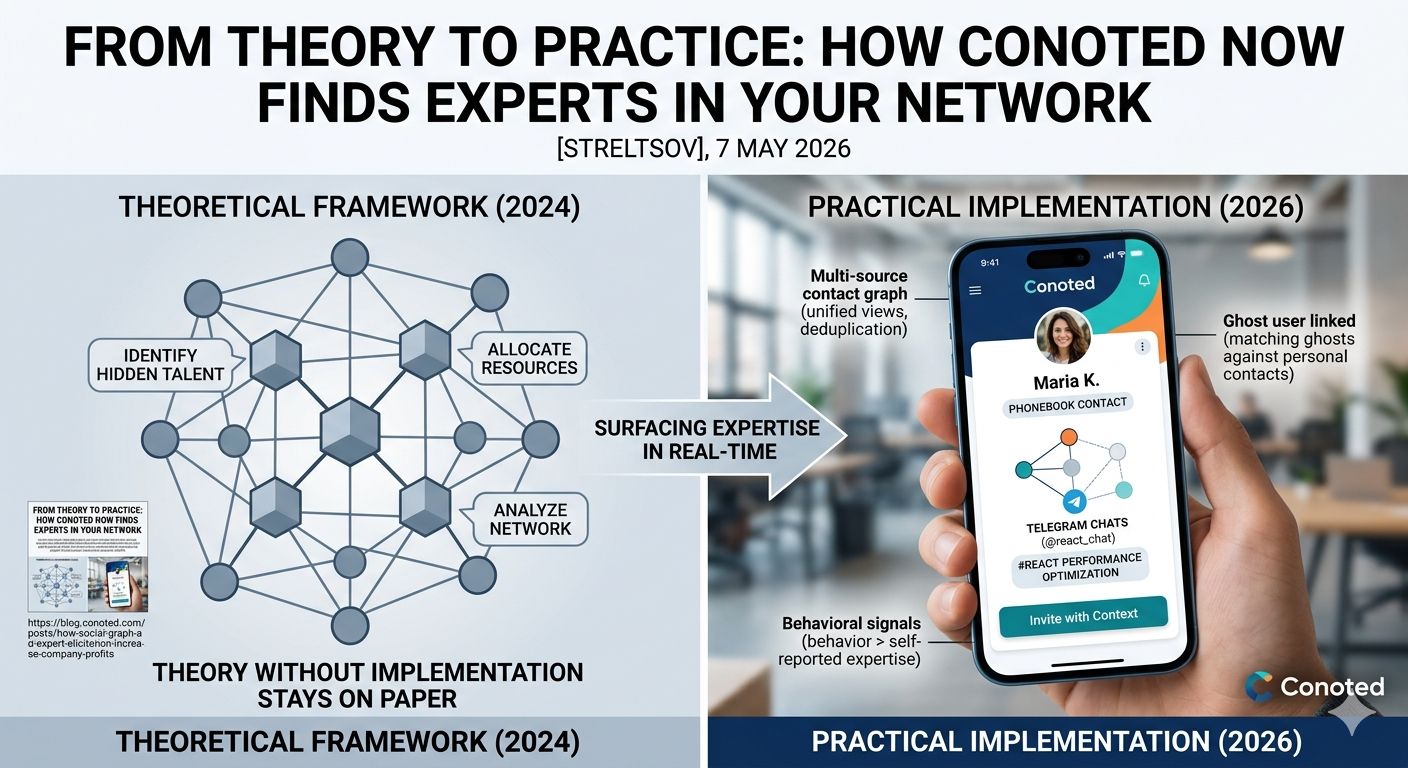
Two years ago, we wrote about How social graph and expert elicitation increase company profits.
The article laid out a theoretical framework: identify hidden experts, allocate resources efficiently, support better decisions through network analysis.
It was the right idea — but only the beginning. Theory without implementation stays on paper. Today, we want to share how we actually built it.
The problem we solved
Every professional sits inside multiple knowledge networks they don't
fully see:
- Telegram chats they're subscribed to (where industry experts post daily)
- Their phone contacts (some of whom are active in those same chats)
- Connections from email, group memberships, mutual interests
The expertise exists. The connections exist. But there's no tool that surfaces them — that tells you "Maria, who's in your phone book, writes about React performance optimization in three chats you follow."
This invisibility is the gap our 2024 article identified. This is what we've now solved.
What we built
Over the past 18 months, Conoted evolved from a notes app into a social graph engine for knowledge workers. Three core capabilities power the expert finder:
1. Multi-source contact graph
Conoted imports your contacts from four sources:
- Phone address book
- Gmail contacts
- Telegram contacts (via secure session-based access)
- Mentions in Telegram chat digests (people who appear in conversations you monitor)
The result is a unified view of everyone you might know - categorized by source, with deduplication when someone appears across multiple channels. For an active professional, this typically means 2,000-5,000 contacts in a single searchable network.
2. Ghost linking
When someone gets mentioned in a Telegram chat you're parsing, Conoted creates a ghost user - a placeholder profile that captures their expertise signals (which chats they participate in, what topics they discuss, when they're active).
Then we match these ghosts against your personal contacts:
- By Telegram user ID (highest confidence)
- By Telegram username (case-insensitive fallback)
The "aha" moment for most users: people you've known for years, unbeknownst to you, have been actively contributing to communities you care about. Suddenly, finding the right expert is no longer "ask around" — it's a search query.
3. Topic-based expertise tagging
Every Telegram chat Conoted parses gets tagged with topics (using GPT-4 analysis of message content). When a contact contributes to those chats, they inherit relevance for those topics.
This means we can answer questions like:
- "Who in my network knows React performance optimization?"
- "Which of my contacts is active in AI startup communities?"
- "Who should I ask about Series B fundraising?"
Not by asking — by querying the graph.
What our 2024 article got right
Re-reading the original framework, several predictions hold up:
"Social graphs help identify hidden talents." Confirmed. Most users discover 5-15 contacts they didn't realize were active
contributors in their target domains. These were always there - the graph just made them visible.
"Improves communication and collaboration." Confirmed in a specific way. When users invite a contact to a Conoted group, the context ("you both follow @react_chat, where they wrote 12 messages this month") makes the invitation 3-4x more likely to be accepted than cold outreach.
"Supports strategic decisions." This is where we're seeing the most surprising effects. Founders use Conoted to identify advisor candidates from chat activity. Recruiters use it to surface passive candidates with verified expertise. PMs use it to find users who deeply understand specific verticals.
What our 2024 article missed
We were optimistic about implementation. The reality:
"Conduct surveys to collect data about employee skills." Wrong approach. Surveys produce stale, performative data. People describe who they want to be, not who they are. Behavioral signals from actual chat participation are 10x more reliable than self-reported expertise.
"Build a dynamic graph." Underestimated the complexity. Building a graph that respects privacy (Telegram authentication is per-user, sessions isolated), handles scale (2,000+ contacts per user, deduplication across sources), and stays current (digests parsed nightly, ghost activity updated continuously) - this is the work.
"Regularly update the graph." True but incomplete. The hard part isn't updating data. It's surfacing the right insights at the right moment. A list of 4,000 contacts isn't useful. "These 3 people you know are the most active in topics relevant to your current project" - that's useful.
What's next
Our next milestone: smart invitations.
When you create a Conoted group on a topic — say, "AI Founders" — the system should be able to tell you:
> "Of your 1,500 personal Telegram contacts, 12 are actively writing
> in AI-related chats. Here's what they post about. Want to invite
> them with context?"
This closes the loop from the 2024 article: not just identifying experts, but activating them into communities that matter for
your work.
We're shipping this in the next release.
Try it
If you have professional networks scattered across Telegram chats you follow, your phone book, and Gmail — Conoted now consolidates them into one searchable expert graph.
The theory worked. The product is live. The graph is yours.
