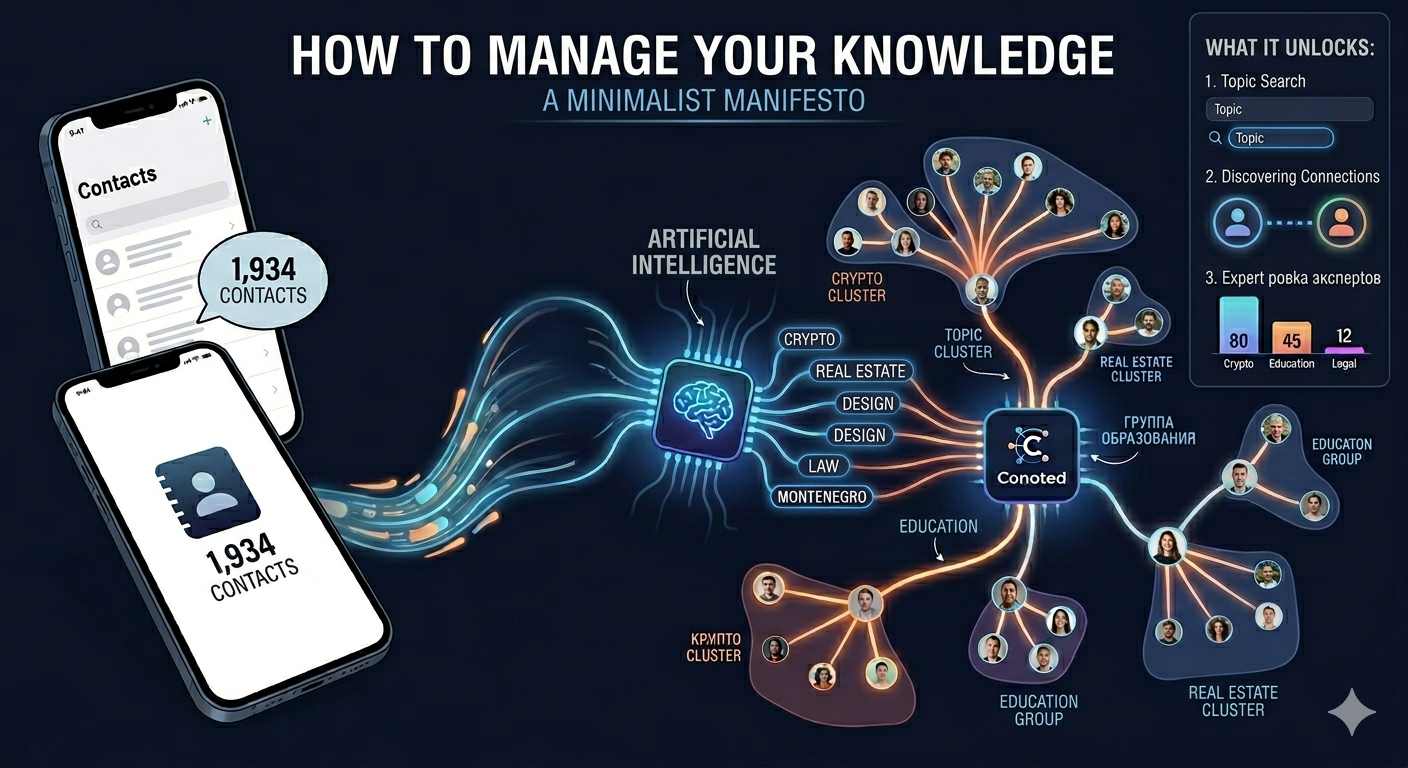
I have 1,934 contacts. I remember 30. Here's how I'm fixing that — and what I learned along the way.
INTRO
Open your phone right now. Go to Contacts. Look at the number. Mine says 1,934. Yours might be 500, or 5,000. But unless you've done something deliberate about this — you're losing.
You're losing because the human brain wasn't designed to hold this many people. Cognitive science gives us Dunbar's number — roughly 150 meaningful relationships. Beyond that, people become invisible.
But your contact list keeps growing. Every conference, every networking event, every Telegram channel, every LinkedIn connection. The list expands. Your memory doesn't.
This is the most expensive form of forgetting I know.
THE TRUE COST
Try this thought experiment.
Last week, you needed something. A specific expertise. A specific person. A lawyer, a designer, a developer, a guide who's been somewhere.
What did you do?
If you're like most professionals — you posted in a WhatsApp group. You Googled. You posted on LinkedIn. You asked a generic question to a generic crowd, and got generic answers.
But somewhere in your contact list — in those thousands of people you've actually met — there was almost certainly someone who knew the answer specifically, who could have given you better advice in five minutes than Google could in two hours.
You just didn't remember they exist.
That cost is invisible. It compounds quietly. Year after year, you're operating with a fraction of the network you actually have access to.
WHY LISTS DON'T WORK
The default answer to "I have too many contacts" is:
- Better organization
- Folders
- Tags
- CRM systems
- Personal databases
I've tried all of them. They all fail. Here's why. Manual organization dies the moment you stop doing it. You can spend a Saturday tagging 200 contacts with their expertise. But next week you'll meet 5 new people, and you won't tag them. The month after that, 20 new contacts go untagged. By the end of the year, your "system" reflects a snapshot from January and is useless.
This isn't a discipline problem. It's a structural problem.
Manual maintenance doesn't scale.
The second failure mode is worse: even when you DO tag everyone, your tags reflect what you THOUGHT they did when you met them. They don't update as people evolve.
A friend who was "marketing at startup X" three years ago is now "VP marketing at startup Y" — your tag is stale, your knowledge of them is fossilized.
THE NETWORK PRINCIPLE
The solution requires changing how you think about contacts.
Your contacts are not a LIST. They're a NETWORK.
Lists are queried by name: "Who is John?"
Networks are queried by topic: "Who in my network knows about X?"
Lists are flat: everyone occupies one slot.
Networks have structure: people cluster by expertise, location, relationship strength.
Lists die in memory: you forget who's there.
Networks come alive through navigation: you discover what you have through exploration.
To build a network from a list, you need three things:
1. EVERY PERSON TAGGED with what they know
2. THOSE TAGS DISCOVERED AUTOMATICALLY, not entered manually
3. A WAY TO NAVIGATE the network by topic, not by name
THE AI PART
Until recently, automatic tagging was impossible.
Now it's not just possible — it's natural.
Here's what I've been building. When you import contacts into Conoted, the system looks at where these people are publicly active. Telegram channels they participate in. Their public messages. The topics they engage with.
AI reads this and produces a tag vector for each person: crypto, defi, real-estate, montenegro, education, design — whatever they actually engage with.
You don't tag anyone. They tag themselves through their own behavior. And critically: the tags update over time. As your contact shifts focus from "marketing" to "AI products," the tags shift with them. The system stays fresh because the source data — their public activity — stays fresh.
WHAT THIS UNLOCKS
Once your contacts are tagged, three things become possible.
ONE — Topic search.
You type "Lisbon real estate" and get three people from your 1,934 contacts who actually know about it. Not random Google results. Real humans you've actually met.
TWO — Introduction discovery.
The system notices: "Andrey and Maria both have these tags in common, plus they live in the same city, but they don't seem to know each other yet." That's a possible introduction. You might never have noticed it.
THREE — Expert clustering.
Your 1,934 contacts cluster naturally into topic groups. You can see at a glance: I have 80 people in crypto. 45 in education. 12 in legal. These clusters are the latent structure of your network — visible for the first time.
THE DEEPER PRINCIPLE
Building this product over two years has clarified something for me about memory itself.
We've been thinking about memory wrong.
Modern productivity advice says: "remember more." Use Anki, use spaced repetition, write things down, keep notes, use a second brain.
But the human brain isn't designed to remember more. It's designed to FORGET STRATEGICALLY — to keep the relevant and let the rest fall away. The problem is that in a world of exponential information growth, "strategic forgetting" leaves too much critical information on the floor.
The right architecture isn't a memory that holds everything.
It's a system that SURFACES the right thing at the right moment.
Forgetting is fine. Forgetting CORRECTLY is the skill.
A good memory system doesn't shout "remember everything!"
It quietly does the work in the background, then taps you
on the shoulder when something relevant appears.
That's what I've been trying to build.
PRACTICAL TAKEAWAYS
If you want to start improving your knowledge network today, even without Conoted:
1. Stop manually tagging. It will fail. Trust me.
2. Capture context, not categories. When you meet someone, note WHERE you met them and WHAT they were excited about. Two pieces of context beat ten manual tags.
3. Re-read your own notes weekly. You forgot what you wrote last month. Reading is how you remember.
4. Look for clusters. When you notice yourself talking to 3 different people about the same topic in a week — that's a cluster forming. Pay attention.
5. Introduce people. Every introduction creates one new edge in your network — and edges are the actual value, not nodes.
WHERE I'M GOING
I'm building Conoted in public. Solo founder. Two years in. 800 active users. Apple Store and Google Play. Zero marketing spend.
The product is real. The thinking is evolving.
If you want to follow the journey, this blog will have:
- Build notes (what shipped, what broke)
- Architecture deep-dives (how the AI works under the hood)
- Use cases (real users, real workflows)
- Philosophy (like this post)
You can try Conoted at conoted.com.
You can read more at blog.conoted.com.
If you have feedback, ideas, or just want to chat about knowledge management — I'm always interested. This product gets better through conversations.
Build with me.
— Evgeny
